Webcam studio recruiting: 1,000+ applications on a $1,000 budget
WHYNOTMAY - JUN 2025
A webcam studio network with no physical offices needed candidates at volume, not cheap clicks. We dropped Meta lead forms for a Telegram bot funnel that explains the job before the application: 1,000+ applications on a $1,000 budget, 80% of them matching the studio's requirements.
Demand for HOT categories was growing faster than the studio could fill shifts. WHYNOT needed candidates ready to work from home, online, and start earning quickly.
The studio has no physical offices. No relocation is required, and it covers training and equipment after the interview. That is a strong offer — but it does not fit on a single ad banner.
Then hiring does what hiring does. An application that never reaches an interview costs the studio more than no application at all, because a human still has to process it. So the brief was not "get us leads."
Two conditions we took on:
volume large enough to keep the studio's recruiters busy without weekly gaps;
a cost per application low enough that, after every drop-off stage, the cost of a candidate who actually starts working stays viable.
What we did
The funnel
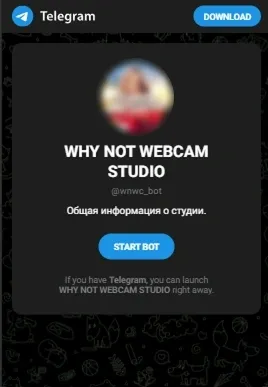
Ad click → bridge landing page → Telegram bot with full details → application → AmoCRM. Four steps instead of two, which is a deliberate decision against intuition: normally every extra screen cuts conversion.
We tested lead forms rather than assumed. They deliver volume and a low cost per lead on paper, but the application comes from someone who read one line of the offer and hit autofill. Only a minority ever reach a conversation.
The bot does three things a form does not. It warms up before the application — the candidate reads the terms, the work format and what the studio provides, then applies already knowing what they are signing up for. It filters out the accidental, because anyone who finishes the dialogue has invested several minutes in the decision. And it scales on the processing side: export to AmoCRM, one queue, nothing lost across hundreds of applications.
Entry point: the bot answers before it asks
For an online-only studio this was the optimal structure. With nothing physical to show, all persuasion has to live in the information — and information is easier to deliver in a dialogue than on a landing page.
Creative
Three principles we never broke:
do not overload with conditions — the creative's job is to get to the landing page, not to explain everything;
do not use complicated phrasing, and no "unique opportunities for self-realisation";
keep the focus on three things: online format, easy start, no relocation.
Communication was direct: no filler, no promises the studio would not confirm at the interview. In recruiting, an inflated offer comes back as drop-off at the hiring stage, which is money already spent.
All ads and landing pages complied with platform requirements: 18+, no explicit content, the offer presented as employment.
Launch and optimisation
Seven days of testing across several hypotheses. Working combinations were identified quickly, then we scaled only the ads producing quality flow — not the cheapest ones.
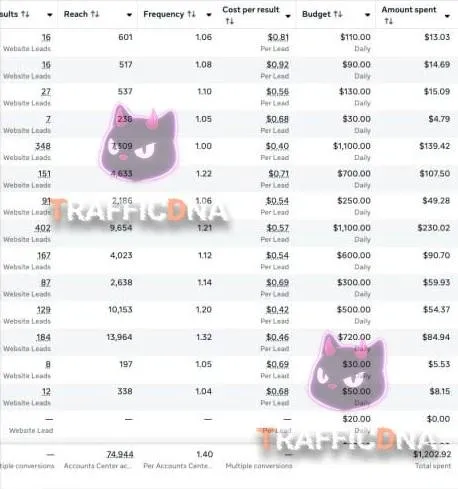
Cost per application varied roughly 2x between combinations, from $0.40 to $0.92. We kept some of the expensive ones running because, per the studio's feedback, they delivered candidates who converted better. Optimising on CPL alone would have quietly removed the best part of the flow.
What happened
After the test period: 1,000+ applications on $1,000 of media budget, 74,944 reach at 1.40 frequency. Per the client's assessment after processing, 80% of applications matched the studio's requirements.
Ad account, full period including tests — $1,202.92
The screenshot covers the whole account, test campaigns included, which is why it totals $1,202.92 rather than $1,000. The headline figures above are the post-test media budget only.
Cost per candidate who actually started working sits on the client's side and is not ours to publish. The $0.40–0.92 above is the cost of an application in the bot, and the gap between those two numbers is the part that matters in recruiting.
Per the client, the campaign not only paid for itself but produced a steady flow of applications instead of one-off spikes.
Why it worked
A simple funnel. Four steps, each with a clear job, no screen that exists "just because."
Clear communication. At every step the audience got an answer to their actual question: what is required of me and what do I get.
No unnecessary barriers. No twenty-field forms, no mandatory phone call, no conditions surfacing at the last minute.
Focus on the result, not the report. A cheap application is not a metric if it never reaches an interview.
What we would carry into the next one
In recruiting, lead forms and bots solve different problems. A form collects contacts, a bot collects intent. Hiring needs the second one.
An extra funnel step pays for itself if it explains something. Warming up before the application is cheaper than warming up after it with a manager's time.
The offer in the creative must match the offer at the interview, or cost per application falls while cost per hire rises.
A 2x spread in cost between combinations is normal. Killing the expensive ones on CPL alone is a way to kill quality.
Questions we get about this one
Can you advertise a webcam studio on Facebook and Instagram? Not the studio itself. The job vacancy — yes, provided creatives and landing page meet platform rules: 18+, no explicit content, the offer presented as employment. Ban risk in this category is above average and has to be planned for: backup accounts, domains and payment methods.
What does a webcam model recruiting application cost? Here, $0.40 to $0.92 depending on the combination, geo and creative. That is the cost of an application in the Telegram bot, not the cost of a candidate who starts working.
Why a Telegram bot instead of a Meta lead form? Lead forms produced more applications and worse quality: people hit autofill without reading the offer. The bot forces them to read the terms first, so conversion into conversation, and into an actual hire, was noticeably higher.
What budget do you need to test this funnel? The benchmark here: seven days and roughly $100–200 to validate hypotheses before scaling. The exact figure depends on geo and how many combinations you want to compare.
Does this work for studios without a physical office? It works best for them. With nothing physical to show, all persuasion moves into information, and information belongs in a dialogue.
How do you measure application quality in recruiting? Not by CPL. The minimum set: share of applications reaching a conversation, share reaching an interview, share starting work. Without a CRM export there is nothing to measure.
The client needed volume, not cheap clicks: in hiring, only a minority of applicants reach a final interview and fewer still start work. Five months and $15,000 of spend produced 3,848 applications at $3.90 — Meta lead forms, broad targeting, static creative on a fast rotation.
3,848Applications from Meta
$3.90Average cost per application
$15,000Ad spend
Tell us what you are trying to move
One message. What you are selling, which countries, what you spend on ads now. You get an answer from someone who has run it, not from a form.